+66.(0)2.149 2642 – 3
Hotline

Hotline
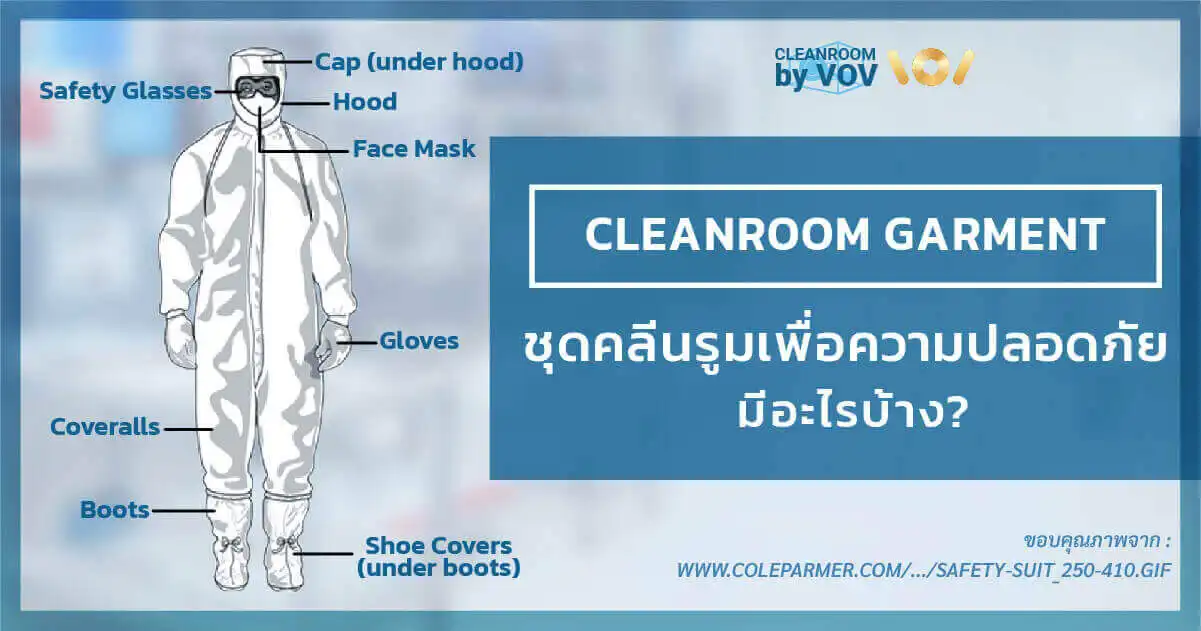
Cleanroom Garment is a special protective suit that all operators must wear every time before entering a cleanroom to prevent the dispersion of dust particles, germs, and contaminants from the human body, which is the main source of pollution in environments requiring high cleanliness.
Cleanrooms in the semiconductor, electronics, pharmaceutical, and medical industries must strictly control the amount of airborne particles in accordance with ISO 14644-1 standards. Therefore, wearing a cleanroom suit correctly and completely is an indispensable and vital condition for those who work in these areas.
This article will introduce you to every part of a cleanroom suit completely, from the cap to the clean boots, along with the functions and reasons for using each piece, including relevant standards, so that you can choose the correct cleanroom suit according to the ISO Class level of your cleanroom.
Cleanroom Garment is a special protective suit made from materials that do not release dust particles. It is designed to prevent contamination from the human body into the cleanroom, covering the head, face, hands, and body in accordance with ISO 14644 standards. The level of strictness of the suit depends on the ISO Class of that particular cleanroom.
Also commonly known as a Bunny Suite or Coverall in colloquial language, a cleanroom suit is a specially made garment for use specifically in cleanrooms or sterile rooms. Its operational concept focuses primarily on controlling the cleanroom environment.
The human body constantly releases particles of various sizes, whether they are shed skin cells, hair, water vapor droplets from breathing, or dust particles attached to daily clothing. Data from the IEST (Institute of Environmental Sciences and Technology) indicates that a human body at rest can release more than 100,000 particles of size 0.3 microns and larger per minute, while walking can release more than 1,000,000 particles per minute.
Cleanroom suits act as the final barrier between the human body and the environment, requiring high cleanliness, which is absolutely essential in highly sensitive manufacturing processes, such as semiconductor component manufacturing, sterile pharmaceutical manufacturing, and medical device manufacturing.
The essential components of a cleanroom suit are designed and manufactured from lightweight, comfortable, and durable materials to prevent particle emission from oneself. A cleanroom suit consists of 8 main components as follows:
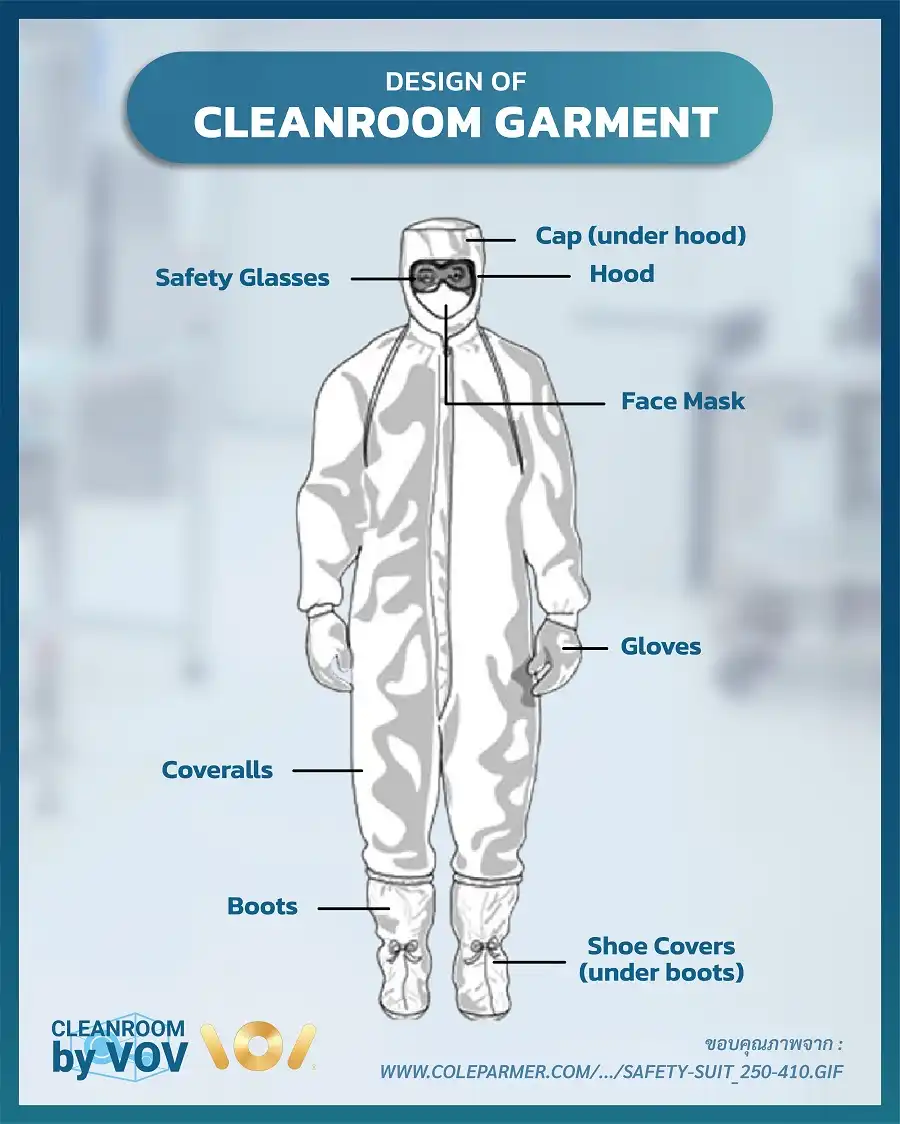
The Cap is made of reusable polyester material, complying with strict ISO 14644 cleanroom standards. It is used to contain hair, scalp cells, and hair shedding caused by head movement. It is typically worn first and fits underneath another layer of the Hood.
Caps used in high-level cleanrooms (ISO Class 3-5) must completely and snugly cover the entire head and facial frame to prevent particle leakage, whereas lower-level cleanrooms (ISO Class 7-8) may use regular caps.
Safety glasses are eye protection devices that come with an adjustable elastic band to fit the head well. They provide greater eye protection than regular safety glasses because they protect against hazards caused by dust and prevent foreign objects from shedding from behind them, such as eyelashes.
In cleanrooms that utilize chemicals or UV light, higher-standard protective eyewear is usually required, such as tighter-fitting goggles, to prevent exposure to hazardous chemicals.
Manufactured from Polypropylene fibers, the special characteristics of this hood are durability, convenience of use, preventing cleanroom emissions from clinging to operators' regular clothes at the same time, and preventing excessive temperature changes. Crucially, this garment must provide anti-static protection for user safety.
A good Hood must completely cover the head, neck, and shoulders, preventing particle leakage from all directions. In high-level cleanrooms, the Hood is often designed as a single piece with the Coveralls to eliminate gaps between different parts.
It should specifically be a Surgical Mask or Medical Mask. Wearing a face mask helps prevent the spread of bacteria from coughing, sneezing, or talking. It helps prevent large-particle droplets containing germs from entering the wearer's mouth and nose, and also helps prevent the wearer's own saliva and germs from spreading to others.
In high-level cleanrooms (ISO Class 3-5) used in the pharmaceutical or food industries, masks with higher particle filtration efficiency are usually required, such as N95 or FFP2, as specified by the FDA.
They must be gloves specifically used in cleanrooms, where particle quantities must be controlled not to exceed the specified Class standards. They are mostly used in various manufacturing processes, such as electronics factories and pharmaceutical industries. Gloves can be divided into 2 types: disposable and reusable (washable).
Glove selection must consider the chemicals used in the manufacturing process. Natural rubber (Latex) material offers good flexibility but may cause allergies. Nitrile material is suitable for most chemicals and does not cause allergies, while Vinyl material is suitable for light-duty work that does not involve harsh chemicals.
Tips: 1) Choose the correct type of glove for the work being performed, including the ability to protect against hazards arising from that specific job, such as anti-static and chemical protection.
2) Before every use, the condition or defects must be inspected. If there are any tears, replace them immediately, especially checking the fingertips, finger webs, punctures, swelling, discoloration, etc.
They are like clean shoe covers that are sterilized before use to prevent contamination from dust particles and other chemicals, and can dissipate static electricity. Cleanroom boots are usually made of materials that prevent Electrostatic Discharge (ESD) accumulation, which is crucial in electronic equipment manufacturing.
Tips: Choose Clean Boots with well-stitched seams. Inspect for any leaks or tears before every use.
These are shoe covers worn over cleanroom shoes to prevent external dirt from entering the factory or site, and also to prevent body contaminants from escaping. Shoe covers possess excellent special properties with high flexibility, making them tear-resistant, slip-resistant while walking, and breathable in cushioned and dry areas.
This is the most important and distinct feature of a cleanroom suit. It features elastic openings for a snug fit around the body and ankles, providing durability and comfort due to its form-fitting tailored design. The suit features specifically integrated gloves to completely cover the hands, protecting against dust and various microbial particles. Some types have an attached Hood, depending on the application requirements.
Coveralls for high-level cleanrooms (ISO Class 1-5) must pass particle emission testing in accordance with ISO 13485 standards and must be cleaned using a special process at a specialized cleanroom laundry facility to certify that the garments meet cleanliness standards before reuse.
The strictness level of the cleanroom suit depends on the ISO Class of the cleanroom. The higher cleanliness the room requires, the more covered and snug the suit must be:
| ISO CLASS | Garment Level | Required Equipment | Industry Examples |
|---|---|---|---|
| ISO 3–4 | Full Bunny Suit | Cap + Hood + Face Mask + Safety Glasses + Full Coveralls + Gloves + Clean Boots + Shoe Cover | Semiconductor (Wafer) |
| ISO 5 | Full Cleanroom Garment | Cap + Hood + Face Mask + Coveralls + Gloves + Clean Boots + Shoe Cover | HDD, Optical, Lenses |
| ISO 6–7 | Standard Garment | Cap + Face Mask + Smock/Coveralls + Gloves + Shoe Cover | PCB Assembly, Pharmaceuticals |
| ISO 8 | Basic Garment | Cap + Face Mask + Smock + Shoe Cover | Food Processing, Packaging |
For more information regarding ISO-standard cleanroom design and construction, please visit VOV's Cleanroom Turnkey Service or Cleanroom Testing Services, providing comprehensive one-stop solutions.
"Cleanroom Garment" is a collective term covering every piece of protective equipment used in a cleanroom. Meanwhile, a "Bunny Suit", also known as a "Coverall", refers to a full-body cleanroom suit (Full Coveralls) that covers both the head and body in a single piece. It is typically used in high-level cleanrooms from ISO Class 1–5, such as semiconductor manufacturing plants or hard disk drive factories.
The frequency of cleaning a cleanroom suit depends on the ISO Class of the room and each factory's policy. Generally, ISO Class 4-5 cleanrooms require the suit to be laundered after every single use, while ISO Class 6-8 rooms may launder them every 1-3 days. Washing must involve a special process in a certified laundry facility; taking them to wash at home is strictly prohibited.
The primary standards for cleanroom garments are ISO 14644-1 , which specifies cleanroom cleanliness levels, and ISO 14644-5, which covers cleanroom operations. This includes IEST-RP-CC003, which is a specific standard for cleanroom garments. For the pharmaceutical industry, they must also comply with GMP and EU Annex 1.
Yes, disposable cleanroom garments are suitable for ISO Class 6-8 cleanrooms or for infrequent visitors. The advantages are convenience, eliminating the need for laundry management, and reducing the risk of cross-contamination. However, for high-level cleanrooms (ISO Class 1-5), washable suits are usually more appropriate because they undergo a standardized cleaning process and release fewer particles.
Selecting gloves for a cleanroom requires considering 3 main factors: (1) Material – Nitrile is suitable for general tasks and offers good chemical protection, while Latex provides high flexibility but may cause allergies; (2) ESD Properties – gloves capable of dissipating static charge must be used for electronics work; and (3) ISO CLASS – ISO Class 3-5 rooms must use gloves specifically certified for cleanroom standards with a very low particle count.
A cleanroom garment (Cleanroom Garment) is not just a protective suit, but a key factor determining the success of environmental control within a cleanroom. Every single piece, from the cap (Cap) to the coveralls (Coveralls), has a specific function in preventing contamination from the human body, which is the primary source of particles in a cleanroom.
Selecting the appropriate cleanroom garment for the room's ISO Class and manufacturing process, as well as following the correct gowning procedure (Gowning Procedure), are practices that must be strictly observed. You can study more information regarding cleanroom equipment and cleanroom design at the VOV website.
VOV International has over 20 years of experience in the design, construction, and testing of cleanrooms for leading domestic and international companies. If you require consultation on cleanroom garments or comprehensive integrated cleanroom system design, our expert team is ready to serve you.
👉 👉 Consult with VOV cleanroom experts for free: https://vovgroup.com/contact-us/
Please fill out the form below completely